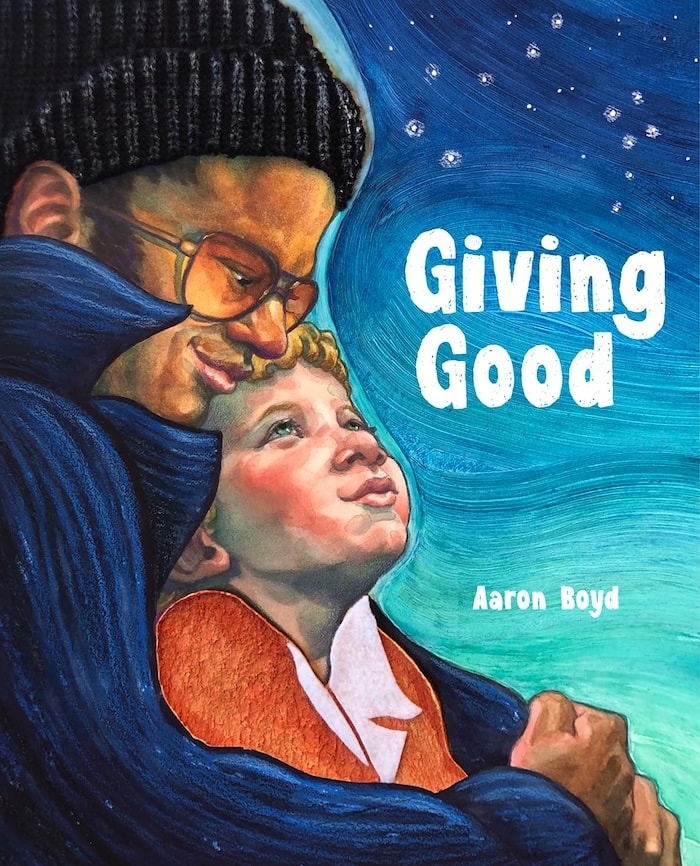
Giving Good
Written & illustrated by Aaron Boyd
What does it mean to give something good? In this warm and joyful picture book, a young child discovers that the best gifts aren't always things you can wrap — they can be time, attention, a smile, or a helping hand. With vibrant illustrations and a gentle, reassuring text, Giving Good invites children to think about what they have to offer the people around them, and to discover that generosity starts from the inside out.
From the Library Director
Giving Good is exactly the kind of picture book that earns a permanent spot in a classroom library. Aaron Boyd writes and illustrates with warmth and clarity, never talking down to young readers but always meeting them where they are. The book's central insight — that generosity isn't just about things, but about how we show up for each other — is one that children can genuinely grasp and act on. This is a book that sparks real conversation: about what it means to be a good friend, about what we have to offer even when we don't have much, about the difference between giving something and giving something good. Perfect for PreK–2, and a natural anchor for SEL units on empathy, kindness, and community.
Big Idea
The best things we can give each other don't always come in a box. Kindness, time, and attention are gifts too — and everyone has them to give.
Discussion Questions
- 1
What are some of the gifts in this book? Which ones can you wrap up and which ones can't you wrap? What's the difference?
- 2
Have you ever given someone a gift that wasn't a thing — like your time or your help? How did it feel? How did the other person feel?
- 3
The book talks about 'giving good.' What do you think makes a gift 'good'? Is it about how much it costs, or something else?
- 4
Who are the people in your life that you like to give things to? What kinds of things do you give them — things, or something else?
- 5
Can you think of a time someone gave you something that wasn't a thing — like their attention or their help? How did that make you feel?
- 6
Is it ever hard to give something good? What makes it hard sometimes? What makes it easier?
- 7
The book says everyone has something good to give. Do you believe that? What do YOU have to give?
- 8
If you could give one person in your life something good today, who would it be and what would you give them? Why?
Activity: My Giving Good Jar
Students identify their own gifts — the non-wrappable kind — and make a plan to give them. This activity builds self-awareness, empathy, and the habit of intentional kindness.
- 1
Before reading, ask students: What is a gift? Take responses — most will say things like toys, books, or money. Then ask: Can a gift be something you can't hold in your hands? What might that look like? Let the conversation open up before introducing the book.
- 2
Read Giving Good aloud. After reading, revisit the question: What kinds of gifts did we see in the book? Make a class list on the board — sort them into 'things' and 'not things.' Discuss: Which column has more? Which gifts do you think meant the most to the people who received them? Why?
- 3
Introduce the Giving Good Jar activity. Each student gets a small paper strip and writes (or draws) one 'giving good' they can offer someone this week — something from the 'not things' column: listening carefully, helping with something hard, saying something kind, playing with someone who is alone, sharing their time. Encourage specificity: not just 'be nice' but 'I will sit with Maya at lunch' or 'I will help my brother with his backpack.'
- 4
Students fold their strips and place them in a class 'Giving Good Jar' (a decorated jar or box). Each day for a week, draw one strip and read it aloud (anonymously if preferred). Ask: Did anyone do their giving good? What happened? How did it feel? Build a culture of noticing and celebrating non-thing gifts.
- 5
At the end of the week, students write or draw a reflection: What giving good did I do this week? How did it feel to give it? How did the other person respond? Share reflections in a circle. Close with the question: What's one giving good you want to keep doing — not just this week, but always?
Standards Connections
CCSS.ELA-LITERACY.RL.K-2.3 — Describe characters in a story and explain how their actions contribute to the sequence of events
CCSS.ELA-LITERACY.RL.K-2.4 — Identify words and phrases in stories or poems that suggest feelings or appeal to the senses
CCSS.ELA-LITERACY.W.K-2.1 — Use a combination of drawing, dictating, and writing to compose opinion pieces that supply a reason for the opinion
CCSS.ELA-LITERACY.SL.K-2.1 — Participate in collaborative conversations with diverse partners about grade-level topics and texts
SEL — Self-Awareness: Identify personal strengths and what one has to offer others; recognize emotions associated with giving and receiving
SEL — Relationship Skills: Demonstrate kindness, empathy, and generosity in interactions with peers; practice intentional acts of care
Ready to use this guide in your classroom?
Download the printable PDF with all questions and activities.