
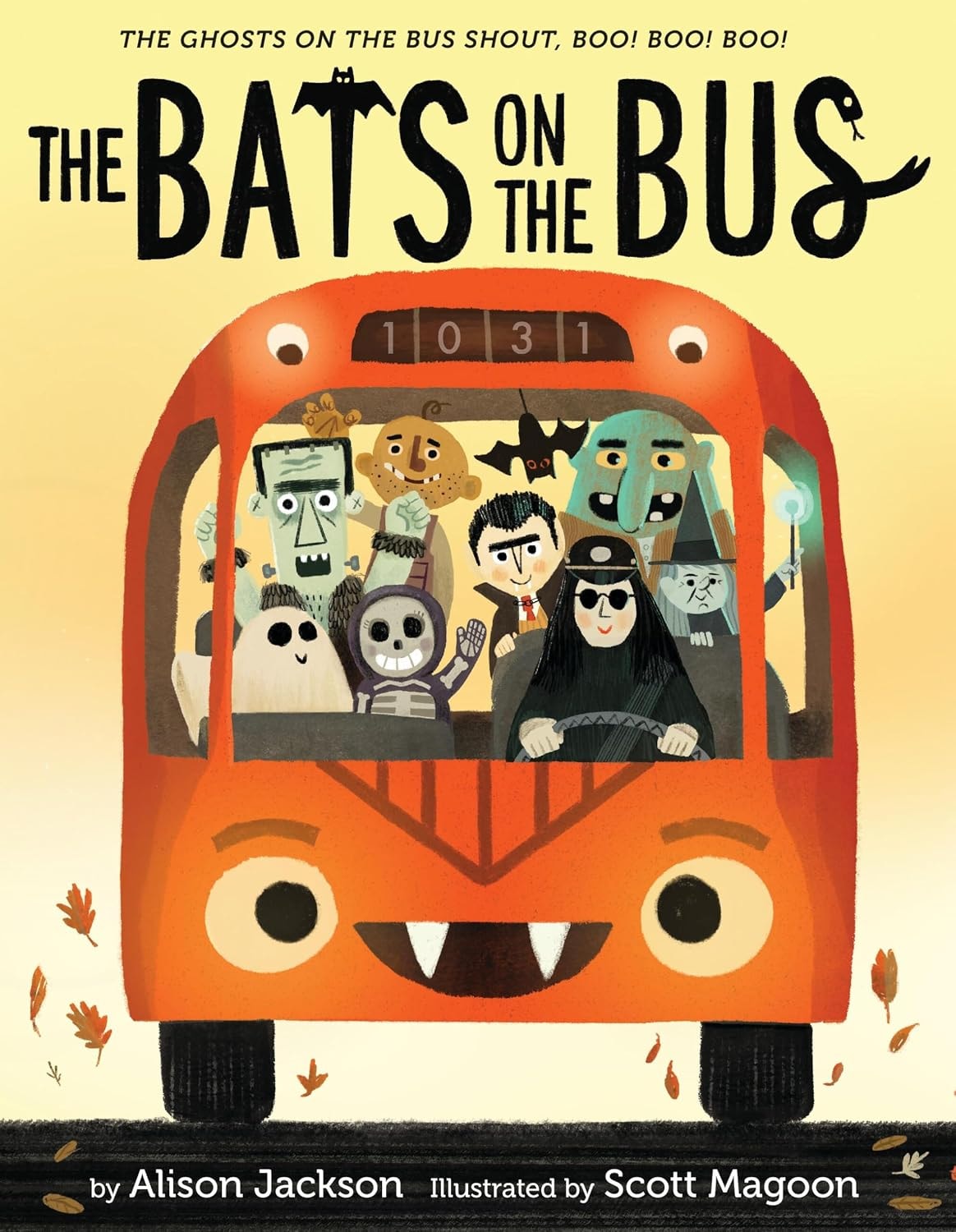
The Bats on the Bus
Written & illustrated by Alison Jackson
What happens when a bus full of bats takes over the route? Chaos, comedy, and a whole lot of upside-down passengers. Alison Jackson's riotous picture book riffs on the beloved 'Wheels on the Bus' song, swapping out the usual riders for a colony of bats with their own very particular habits — echolocating, hanging from the handrails, and generally making the commute absolutely unforgettable. With bouncy, read-aloud-ready text and illustrations bursting with bat-fueled mayhem, this is a book that will have children begging to read it again and again.
From the Library Director
Alison Jackson has a gift for taking something children already know and love — a song, a story, a familiar structure — and spinning it into something completely, delightfully unexpected. The Bats on the Bus is pure read-aloud gold: the rhythm is irresistible, the jokes land perfectly for the PreK–2 crowd, and the illustrations are packed with the kind of visual gags that reward repeated reading. This is the book you reach for when you need to get a wiggly group settled and laughing at the same time. Essential for any early childhood collection, and a perfect anchor for lessons on rhyme, pattern, and the joy of wordplay.
Big Idea
Familiar things become funny and fresh when you look at them from a completely different angle — or upside down.
Discussion Questions
- 1
What song does this book remind you of? How is 'The Bats on the Bus' the same as 'The Wheels on the Bus'? How is it different?
- 2
Why is it funny that bats are on the bus? What do bats do that makes them silly passengers? What would be the hardest thing about riding a bus with bats?
- 3
The book has a pattern — each page shows the bats doing something on the bus. What is the pattern? Can you predict what might come next?
- 4
Bats use echolocation to find their way around. What is echolocation? How might that cause problems on a bus full of passengers?
- 5
If you were on the bus with the bats, how would you feel? What would you do? Would you stay on the bus or get off at the next stop?
- 6
The author changed 'people' to 'bats' to make a new story. What other animals could you put on the bus? What would they do that would be funny or surprising?
- 7
What makes this book funny? Is it the words, the pictures, or both? Can you find a page that made you laugh the most?
- 8
At the end of the book, what happens? Do you think the bats will ride the bus again? What do you think the bus driver is thinking?
Activity: The _______ on the Bus
Students create their own animal-on-the-bus verse, practicing rhyme, pattern, and the art of the unexpected — then perform their verses as a class song.
- 1
Before reading, sing 'The Wheels on the Bus' together as a warm-up. Then ask: What if the passengers weren't people? What if they were animals? What would be the funniest animal to put on a bus? Take a few suggestions and enjoy the silliness. Then introduce the book: someone already wrote this story!
- 2
Read The Bats on the Bus aloud with full expression — encourage students to join in on the repeated refrains. After reading, discuss: What pattern did you notice? How did the author use what we know about bats to make the jokes work? What made each page funny?
- 3
Introduce the concept of a parody: a new story that uses the structure of a familiar story or song but changes something to make it funny or surprising. Ask: What did Alison Jackson keep the same? What did she change? Why does changing just one thing (people → bats) make the whole thing funny?
- 4
Students choose their own animal and write one verse of 'The _______ on the Bus' following the pattern: what the animal does on the bus, the sound or action it makes, and the repeated refrain. Encourage them to think about what their animal actually does in real life — that's where the humor comes from. Students illustrate their verse on a half-sheet.
- 5
Compile all verses into a class book or perform them as a class song, with each student leading their own verse. Discuss: Which verses were the funniest? Why? What made the animal choices work? Connect back to the book: Alison Jackson did exactly this — she thought about what bats really do and made it funny by putting them somewhere they don't belong.
Standards Connections
CCSS.ELA-LITERACY.RL.K-2.4 — Identify words and phrases in stories or poems that suggest feelings or appeal to the senses; recognize rhyme and rhythm
CCSS.ELA-LITERACY.RL.K-2.5 — Explain major differences between books that tell stories and books that give information; identify the overall structure of a story
CCSS.ELA-LITERACY.W.K-2.3 — Use a combination of drawing, dictating, and writing to narrate a single event or several loosely linked events in sequence
CCSS.ELA-LITERACY.SL.K-2.4 — Describe familiar people, places, things, and events with relevant details, expressing ideas and feelings clearly
Music/Performing Arts — Singing: Demonstrate the ability to sing a simple song with accurate pitch, rhythm, and expression; perform with others
SEL — Social Awareness: Demonstrate empathy and understanding of others' perspectives; recognize humor as a way to connect with others and build community
Ready to use this guide in your classroom?
Download the printable PDF with all questions and activities.