
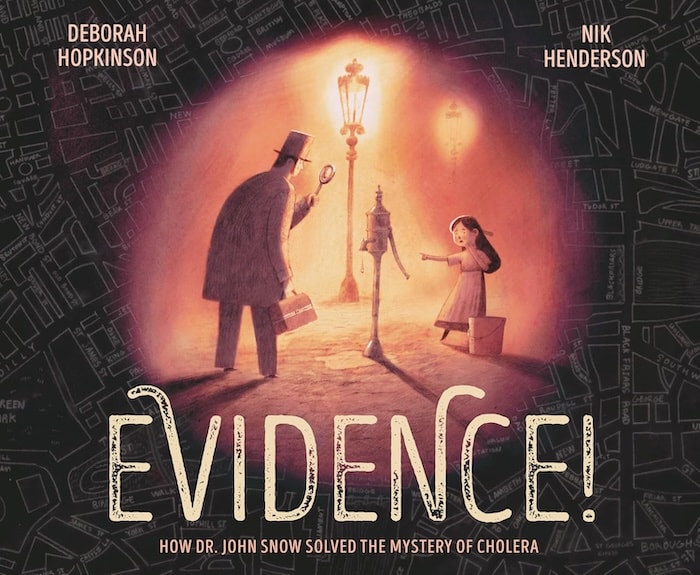
Evidence!
How Dr. John Snow Solved the Mystery of Cholera
Written by Deborah Hopkinson
Illustrated by Nik Henderson
London, 1854. A deadly outbreak of cholera is sweeping through the crowded Soho neighborhood, and no one knows why. Most doctors believe disease travels through bad air — but Dr. John Snow thinks differently. Armed with a notebook, a map, and an unshakeable belief in evidence, he sets out to trace the outbreak to its source. In this gripping, beautifully illustrated picture book, Deborah Hopkinson brings to life one of history's greatest detective stories — and one of the founding moments of modern public health and epidemiology.
From the Library Director
Deborah Hopkinson is one of the finest writers of narrative nonfiction for children working today, and Evidence! is a masterclass in the form. She takes a genuinely thrilling true story — a cholera outbreak, a lone doctor, a water pump, a map — and renders it with the pace and tension of a mystery novel. Nik Henderson's illustrations are atmospheric and gorgeous, capturing the gaslit streets of Victorian London with real drama. This is a book that makes children feel what it's like to think like a scientist: to gather clues, question assumptions, and follow the evidence wherever it leads. Essential for any 2–5 collection, and a perfect anchor for units on scientific inquiry, public health, or historical thinking.
Big Idea
Science isn't just about what you know — it's about how you find out. Evidence, careful observation, and the courage to question what everyone believes can change the world.
Discussion Questions
- 1
What was the mystery Dr. John Snow was trying to solve? Why was it so important to solve it quickly?
- 2
Most people at the time believed cholera spread through bad air. Why do you think it's hard to question what everyone else believes? What gave Dr. Snow the courage to think differently?
- 3
Dr. Snow used a map to track where sick people lived. How did the map help him solve the mystery? Can you think of other problems where mapping information might help?
- 4
What is evidence? What kinds of evidence did Dr. Snow collect? Why is evidence so important in science — and in everyday life?
- 5
Dr. Snow was a doctor, but he acted more like a detective in this story. What do scientists and detectives have in common? How is solving a scientific mystery like solving a crime?
- 6
When Dr. Snow presented his findings, not everyone believed him right away. How do you think that felt? What does this tell us about how scientific ideas get accepted?
- 7
The story takes place in 1854. How is medicine and public health different today because of what Dr. Snow discovered? Can you think of ways his work still affects your life?
- 8
If you were investigating a mystery in your school or neighborhood, what steps would you take? What evidence would you look for? How would you present your findings?
Activity: Map the Mystery
Students practice scientific inquiry and data mapping by recreating Dr. Snow's investigation — then apply the same thinking to a mystery of their own.
- 1
Before reading, ask students: What is a hypothesis? What does it mean to 'follow the evidence'? Have you ever had to figure out why something happened by looking for clues? Introduce the idea that scientists are like detectives — they gather evidence, look for patterns, and test their ideas.
- 2
Read Evidence! aloud. After reading, discuss: What was Dr. Snow's hypothesis? What evidence did he gather? How did the map help him see a pattern he couldn't see any other way? What happened when he removed the pump handle — and why was that the key test?
- 3
Introduce the concept of epidemiology: the science of tracking how diseases spread through populations. Dr. Snow is considered the father of epidemiology. Discuss: Why is it important to know HOW a disease spreads, not just WHAT causes it? How does this kind of thinking help us respond to outbreaks today (connect to COVID-19, flu season, food poisoning outbreaks — age-appropriate examples).
- 4
Map the Mystery activity: give students a simplified grid map of a fictional school or neighborhood. Provide a list of 15–20 'cases' (students or residents who got sick), each with a location on the map. Students plot the cases, look for clusters, and form a hypothesis about the source. Then reveal additional clues (a shared water fountain, a cafeteria, a classroom) and test their hypothesis. Discuss: Did the map help? What patterns did you see? Did your hypothesis change as you got more evidence?
- 5
Students write a one-paragraph 'scientific report' in Dr. Snow's voice: what they observed, what hypothesis they formed, what evidence they gathered, and what conclusion they reached. Share with the class. Discuss: What made some investigations stronger than others? What would you do differently? Connect back to Dr. Snow: this is exactly the process he followed — and it saved lives.
Standards Connections
CCSS.ELA-LITERACY.RI.2-5.3 — Describe the relationship between a series of historical events, scientific ideas, or steps in a technical procedure using language that pertains to time, sequence, and cause/effect
CCSS.ELA-LITERACY.RI.2-5.6 — Determine an author's point of view or purpose in a text and explain how it is conveyed in the text
CCSS.ELA-LITERACY.W.2-5.2 — Write informative/explanatory texts to examine a topic and convey ideas and information clearly
NGSS 3-5-ETS1-1 — Define a simple design problem reflecting a need or want that includes criteria for success and constraints on materials, time, or cost
NGSS Science & Engineering Practices — Asking questions, planning and carrying out investigations, analyzing and interpreting data, constructing explanations
Social Studies — Historical Thinking: Analyze cause-and-effect relationships; evaluate the impact of individuals on historical events and scientific progress
Ready to use this guide in your classroom?
Download the printable PDF with all questions and activities.