
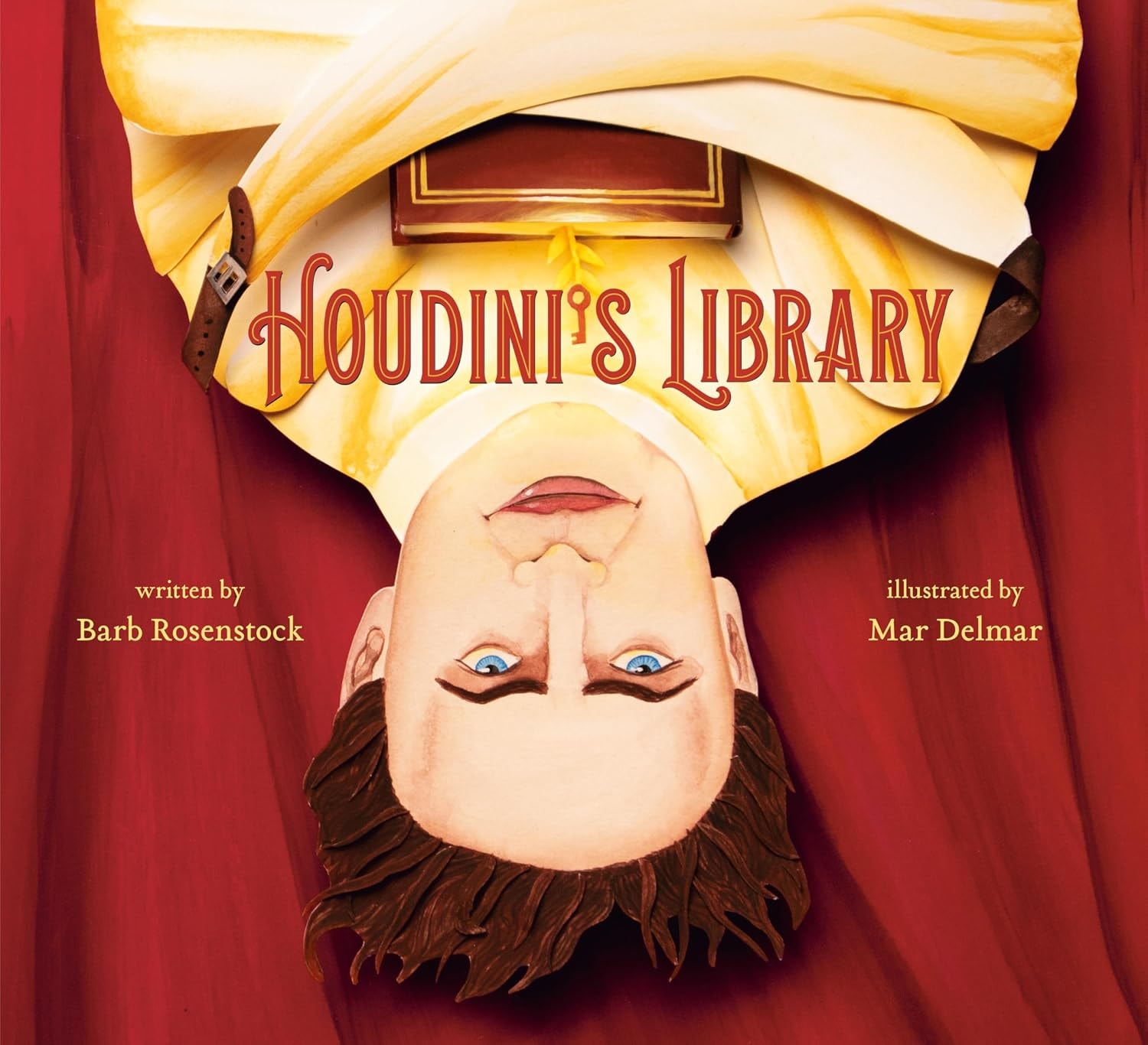
Houdini's Library
How Books Created the World's Greatest Magician
Written by Barb Rosenstock
Illustrated by Barb Rosenstock
Before Harry Houdini was the world's greatest escape artist, he was a boy who couldn't stop reading. In this captivating picture book biography, Barb Rosenstock reveals how books — stacked, borrowed, devoured — gave young Ehrich Weiss the knowledge, courage, and imagination to become the legendary Houdini. A love letter to libraries, reading, and the transformative power of stories.
From the Library Director
This is a librarian's dream book. Barb Rosenstock has written a biography that makes the case — beautifully, compellingly — that libraries and reading made Houdini who he was. The connection between books and possibility is woven into every page. A perfect read-aloud for any library program, and a wonderful anchor for conversations about why reading matters beyond school. I recommend it enthusiastically for every K–3 classroom and library collection.
Big Idea
Books don't just teach us facts — they give us the tools to imagine who we might become and the courage to try.
Discussion Questions
- 1
What kinds of books did young Ehrich (Houdini) love to read? How did those books help him become a magician and escape artist?
- 2
Houdini used what he learned from books to do things that seemed impossible. Can you think of something you learned from a book that helped you do something in real life?
- 3
Why do you think the library was such an important place for Houdini? What does a library give people that they might not be able to get anywhere else?
- 4
Houdini practiced and practiced until he could do things no one else could do. What is something you have worked hard to get better at? How did you keep going when it was difficult?
- 5
The book is called Houdini's Library. What do you think that title means? Why is the library connected to who Houdini became?
- 6
Houdini started as a poor immigrant boy named Ehrich Weiss. How did reading help him change his life? Do you think that could still happen today?
- 7
What is the most interesting thing you learned about Houdini from this book that you didn't know before?
- 8
If you could read any book to help you become something amazing, what would it be about? What do you dream of becoming?
Activity: My Magic Book Stack
Students explore the connection between reading, imagination, and identity through a creative writing and art activity inspired by Houdini's voracious reading life.
- 1
Before reading, ask students: Has a book ever taught you something that helped you do something in real life — a skill, an idea, a way of thinking? Share a few examples.
- 2
Read Houdini's Library aloud. After reading, discuss: What kinds of books did Houdini read? How did each type of book help him in a specific way? Make a list on the board (e.g., books about locks → escape tricks; books about strength → physical feats).
- 3
Discuss: Houdini had a big dream — to be the world's greatest magician. He used books as tools to get there. What is a big dream you have? What kinds of books might help you get there?
- 4
Students create a 'Magic Book Stack' — draw a tall stack of 4–6 books, each one labeled with a subject or title that would help them achieve their dream. On the side of each book, write one sentence explaining how that book would help.
- 5
Share book stacks with the class or a partner. Display them in the library or classroom. Discuss: What do our book stacks tell us about our dreams? How is a library like a toolbox for your future?
Standards Connections
CCSS.ELA-LITERACY.RI.K-3.3 — Describe the connection between a series of historical events, scientific ideas, or steps in a technical procedure
CCSS.ELA-LITERACY.RI.K-3.6 — Distinguish their own point of view from that of the author of a text
CCSS.ELA-LITERACY.RL.K-3.7 — Use information gained from illustrations and words to demonstrate understanding of characters and setting
CCSS.ELA-LITERACY.W.K-3.7 — Participate in shared research and writing projects
SEL — Self-Awareness: Identify personal strengths, interests, and aspirations and connect them to future possibilities
Library & Information Literacy — Recognize that libraries and books are resources for pursuing personal goals and developing skills
Ready to use this guide in your classroom?
Download the printable PDF with all questions and activities.