
Sundust
Written by Zeke Peña
Illustrated by Zeke Peña
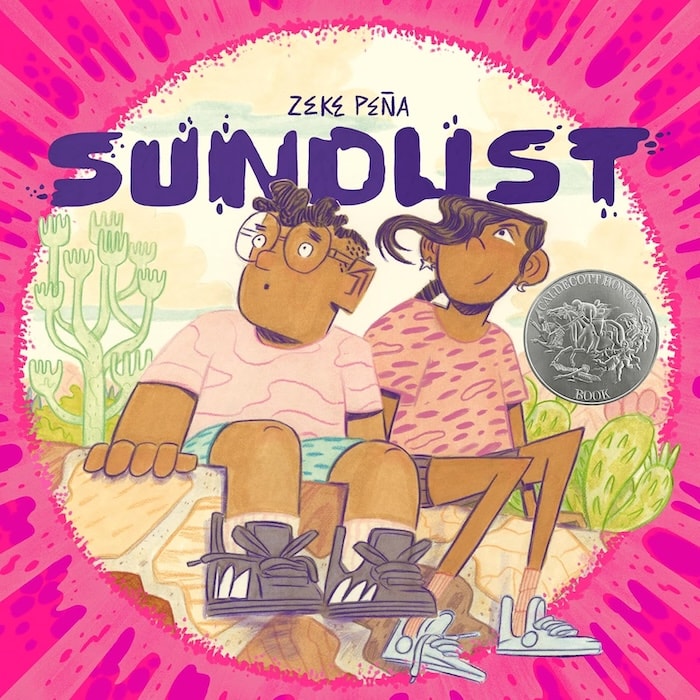
A Caldecott Honor book bursting with color and heart. Two cousins spend a summer day together in the desert Southwest, exploring their neighborhood, sharing stories, and discovering the magic in the everyday world around them. With Zeke Peña's vibrant, graphic illustrations and a deep sense of place, Sundust is a joyful celebration of family, culture, and the bonds that hold us together.
From the Library Director
Sundust is a Caldecott Honor book for good reason — Zeke Peña's art is unlike anything else in picture books right now. Bold, graphic, and full of cultural specificity, this is a book that centers Latinx childhood experience with warmth and authenticity. A wonderful choice for any unit on family, community, or sense of place, and a great conversation starter about the stories embedded in the landscapes we call home.
Big Idea
The places we grow up and the people we grow up with shape who we are — and the ordinary moments we share become the stories we carry forever.
Discussion Questions
- 1
What do the two cousins do together during their summer day? What does their relationship feel like to you?
- 2
The story takes place in the desert Southwest. What details does Zeke Peña include to show this specific place? How does the setting feel different from other picture books you've read?
- 3
Have you ever spent a special day with a cousin, sibling, or close friend? What did you do? What made it memorable?
- 4
Look closely at the illustrations. How does Zeke Peña use color and shape differently from most picture books? What feeling do his illustrations give you?
- 5
What does 'sundust' mean to you after reading the book? Why do you think the author chose that word as the title?
- 6
The cousins explore their neighborhood together. What do they notice? What does it mean to really pay attention to the place where you live?
- 7
How does the book show culture and family identity? What details tell you something about who these characters are and where they come from?
- 8
If you were going to write a book about a perfect day in your neighborhood with someone you love, what would happen in it? What would you want readers to notice?
Activity: My Neighborhood Map
Students explore place, identity, and memory through a creative mapping and storytelling activity inspired by the book's vivid sense of setting.
- 1
Before reading, ask students: What is one thing you love about your neighborhood or the place where you live? What makes it feel like yours? Record a few responses.
- 2
Read Sundust aloud, pausing to let students look closely at the illustrations. After reading, ask: What details did Zeke Peña include to make this place feel real and specific? Make a list on the board.
- 3
Discuss: What makes a place feel like home? Is it the people? The landscape? The food? The sounds? The memories?
- 4
Students draw a 'neighborhood map' — not a realistic map, but an illustrated one showing the places that matter most to them: a favorite tree, a friend's house, a corner store, a park. Encourage bold colors and personal details, inspired by Peña's graphic style.
- 5
Students add labels or short captions to their maps explaining why each place matters. Share with the class. Discuss: How are our maps similar? How are they different? What do our maps tell us about who we are?
Standards Connections
CCSS.ELA-LITERACY.RL.K-3.7 — Use information gained from illustrations and words to demonstrate understanding of characters, setting, or plot
CCSS.ELA-LITERACY.RL.K-3.6 — Identify who is telling the story and describe how different narrators affect the story
CCSS.ELA-LITERACY.W.K-3.3 — Write narratives using descriptive details and temporal words to signal event order
Social Studies — Place and Region: Describe how people's lives are shaped by the physical and cultural characteristics of the places they live
SEL — Self-Awareness: Identify personal, family, and cultural strengths and how they shape identity
SEL — Social Awareness: Demonstrate respect and appreciation for diverse cultural backgrounds and family structures
Ready to use this guide in your classroom?
Download the printable PDF with all questions and activities.