
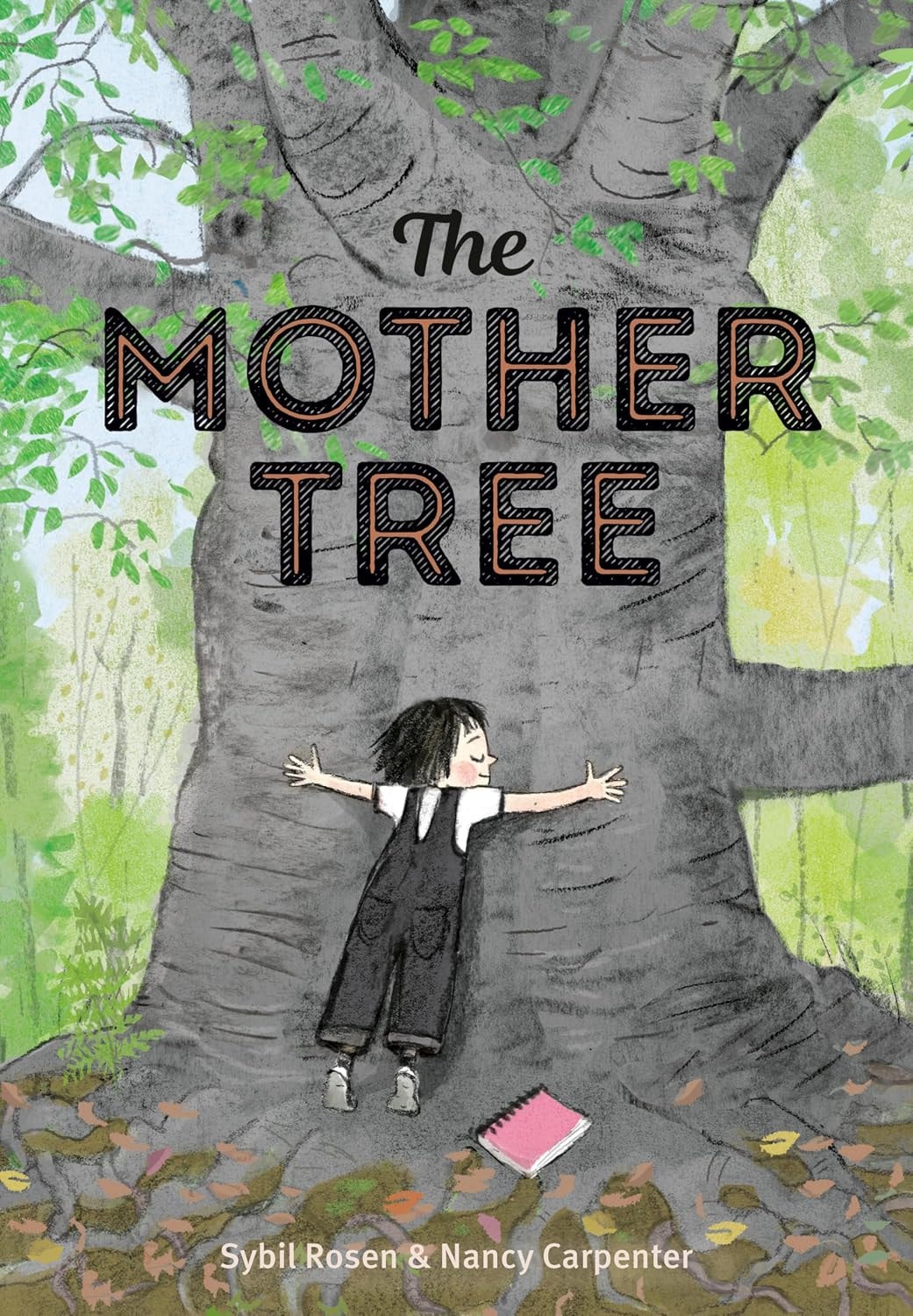
The Mother Tree
Written by Sybil Rosen
Illustrated by Nicole Wong
When a beloved old tree in the backyard must be cut down, a young girl is heartbroken — but her grandmother helps her understand that the tree's life doesn't simply end. Seeds, roots, memories, and the love we pour into the living world all continue on in ways we can't always see. The Mother Tree is a gentle, profound story about grief, the cycles of nature, and the enduring connections between people, trees, and time.
From the Library Director
Sybil Rosen handles grief with such care and honesty in this book — it never flinches from the sadness, but it also never leaves kids stranded there. The grandmother is one of my favorite characters in recent picture books: she's wise without being preachy, and she meets the child exactly where she is. Nicole Wong's illustrations are lush and detailed, full of the kind of close observation of the natural world that makes kids want to look more carefully at the trees around them. I've used this with K–3 and it works beautifully for any conversation about loss — not just trees, but pets, people, places. It's also a wonderful pairing for a science unit on forest ecosystems or the life cycle of trees. The science is woven in naturally, never forced.
Big Idea
Nothing that is truly loved ever disappears completely — in nature and in life, endings are also beginnings.
Discussion Questions
- 1
Why was the girl so sad about the tree being cut down? Have you ever felt sad about losing something in nature — a tree, a garden, an animal?
- 2
What did the grandmother mean when she said the tree's life doesn't end? Do you think she was right? Why or why not?
- 3
What are some of the ways the tree's life continues after it's cut down? Think about seeds, roots, wood, memories, and the animals that lived in it.
- 4
Why do you think the author called it 'the mother tree'? What does a mother tree do for the forest around it?
- 5
The grandmother helps the girl understand something hard. Has an older person ever helped you understand something that felt too big or too sad? What did they say or do?
- 6
How is losing a tree similar to other kinds of loss — like losing a pet or a person you love? How is it different?
- 7
What do you think the girl will remember about the tree when she grows up? What would you want to remember?
- 8
If you could plant a tree today that would still be standing when your grandchildren are your age, what kind of tree would you choose? What would you hope it meant to them?
Activity: A Tree's Life Story
Students research and map the full life of a tree — from seed to old growth to what happens after it falls — building science knowledge about forest ecosystems while reflecting on cycles, continuity, and what it means for something to 'live on.'
- 1
Choose a tree species — it can be one from your neighborhood, your schoolyard, or one you find interesting. Research its life cycle: How does it begin? How long does it live? How tall and wide does it grow? What animals depend on it? Write down at least five facts.
- 2
Draw a timeline of your tree's life across a long horizontal page. Mark key stages: seed, seedling, young tree, mature tree, old-growth tree, fallen log, decomposed matter returning to soil. Illustrate each stage with a small drawing and a label.
- 3
Now add the living things connected to your tree at each stage. Which birds nest in it? Which insects live under its bark? Which fungi help break it down? Which plants grow in the gap of light when it falls? Draw arrows showing these connections.
- 4
Write a short reflection: In what ways does your tree 'live on' after it dies? What surprised you about how connected one tree is to so many other living things? Share with the class and discuss: How does understanding a tree's full life change the way you feel about cutting one down?
Standards Connections
CCSS.ELA-LITERACY.RL.1.3 — Describe characters, settings, and major events in a story, using key details.
CCSS.ELA-LITERACY.RL.2.4 — Describe how words and phrases supply rhythm and meaning in a story, poem, or song.
CCSS.ELA-LITERACY.W.2.3 — Write narratives in which they recount a well-elaborated event or short sequence of events, include details to describe actions, thoughts, and feelings.
NGSS 2-LS4-1 — Make observations of plants and animals to compare the diversity of life in different habitats.
NGSS 5-LS2-1 — Develop a model to describe the movement of matter among plants, animals, decomposers, and the environment.
Social-Emotional Learning — Processing loss and change: developing language and frameworks for grief, continuity, and finding meaning in endings.
Ready to use this guide in your classroom?
Download the printable PDF with all questions and activities.