
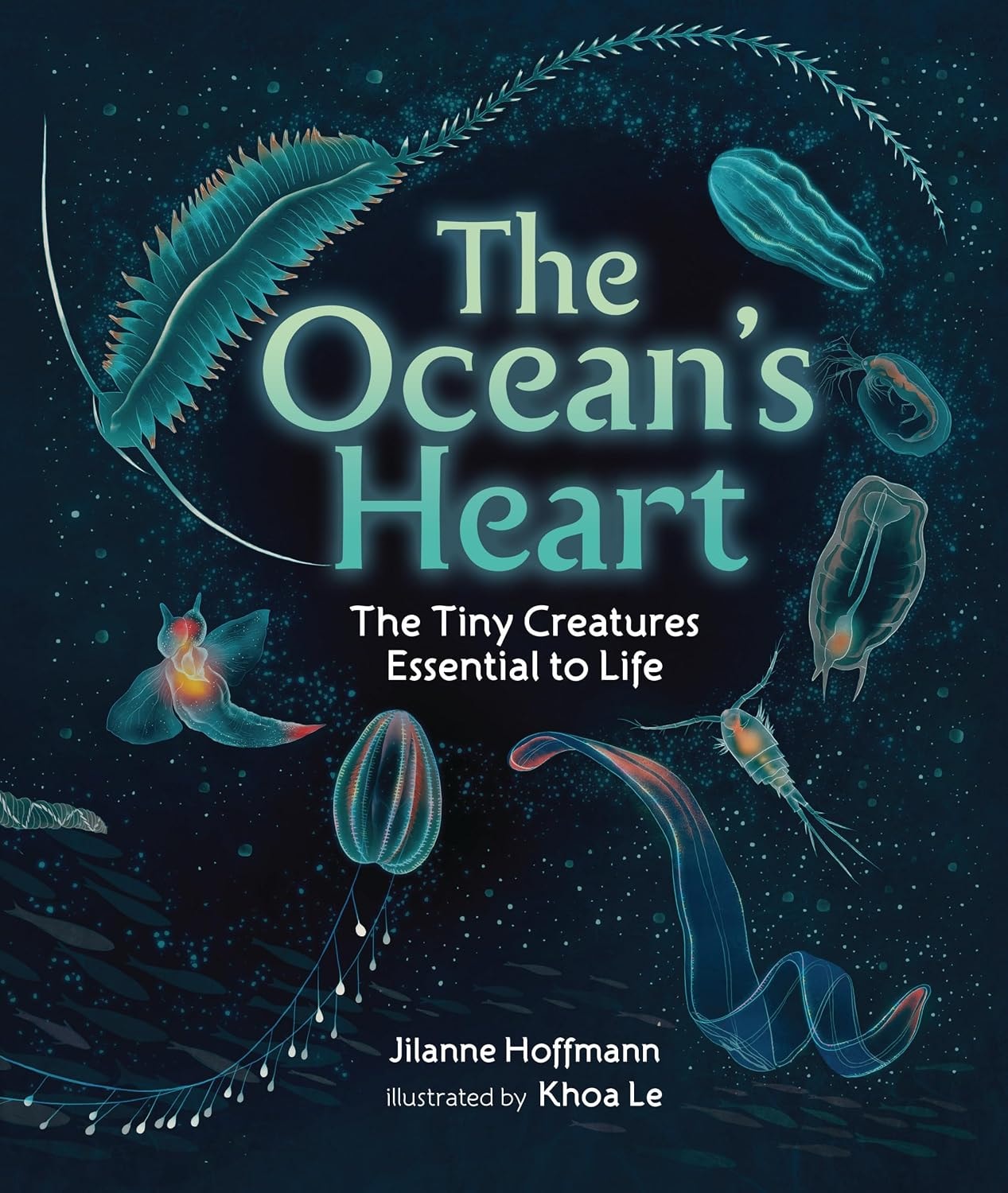
The Ocean's Heart: The Tiny Creatures Essential to Life
Written by Jilanne Hoffmann
Illustrated by Yuko Shimizu
Beneath the surface of every ocean lives a world so small it's invisible to the naked eye — and yet without it, life on Earth could not exist. In The Ocean's Heart, Jilanne Hoffmann takes young readers on a breathtaking journey into the world of phytoplankton and zooplankton, revealing how these microscopic creatures produce half the world's oxygen, anchor the marine food web, and regulate the climate. Yuko Shimizu's stunning illustrations make the invisible visible in the most beautiful way.
From the Library Director
This is exactly the kind of book I love to put in front of kids who think they already know what's interesting about the ocean. Sharks and whales get all the attention, but Jilanne Hoffmann makes a completely compelling case that the real story is happening at the microscopic level — and she does it without ever losing the sense of wonder. Yuko Shimizu's illustrations are extraordinary: lush, detailed, almost otherworldly. The science is solid and age-appropriate for grades 2–5, and it pairs beautifully with any ocean or ecology unit. I've also used it as a standalone read-aloud to spark conversation about what we can't see and why it matters. Kids are genuinely astonished by the phytoplankton-oxygen connection.
Big Idea
The smallest things can matter the most — and understanding the invisible world of the ocean is essential to protecting the future of all life on Earth.
Discussion Questions
- 1
What are phytoplankton and zooplankton? Before reading this book, did you know they existed? What surprised you most about them?
- 2
The book says phytoplankton produce about half of all the oxygen on Earth. Why do you think most people don't know this? Why does it matter?
- 3
How do tiny plankton connect to large animals like whales, seabirds, and even humans? What would happen if plankton disappeared?
- 4
What threats do plankton face? How are human activities affecting the ocean's tiniest creatures?
- 5
Yuko Shimizu's illustrations make microscopic creatures look enormous and beautiful. How did the illustrations change the way you thought about plankton?
- 6
The title calls plankton 'the ocean's heart.' Why do you think the author chose that phrase? What does it mean for something to be the 'heart' of a system?
- 7
Can you think of other examples in nature where something very small or invisible plays a huge role? What does this tell us about how ecosystems work?
- 8
What is one thing you could do — or one thing people could do together — to help protect the ocean and the tiny creatures that live in it?
Activity: The Invisible Web: Mapping an Ocean Food Chain
Students build a visual ocean food web starting from phytoplankton, tracing energy and life through the marine ecosystem all the way to apex predators — and then explore what happens when one link is removed.
- 1
Start with phytoplankton at the center of a large blank page. Draw a circle and label it. Then add zooplankton, small fish, larger fish, seabirds, marine mammals, and any other ocean creatures you know. Draw arrows showing who eats whom — energy always flows from the eaten to the eater.
- 2
Now add the sun at the top (phytoplankton need sunlight to grow) and humans at the edge (we eat seafood, we affect the ocean). Draw arrows connecting them to your web. How many connections can you find?
- 3
Choose one creature in your web and imagine it disappears — due to pollution, climate change, or overfishing. Draw an X through it. Now trace all the arrows connected to it. Which other creatures would be affected? How far does the impact spread? Write two to three sentences describing what would happen.
- 4
Share your food web with the class. Discuss: Which removal caused the most damage? Why does removing phytoplankton affect the web differently than removing a large predator? What does this tell us about the importance of protecting the base of the food chain?
Standards Connections
CCSS.ELA-LITERACY.RI.3.3 — Describe the relationship between a series of scientific ideas or concepts in a text, using language that pertains to time, sequence, and cause/effect.
CCSS.ELA-LITERACY.RI.4.7 — Interpret information presented visually, orally, or quantitatively and explain how the information contributes to an understanding of the text.
CCSS.ELA-LITERACY.W.3.2 — Write informative/explanatory texts to examine a topic and convey ideas and information clearly.
NGSS 5-LS2-1 — Develop a model to describe the movement of matter among plants, animals, decomposers, and the environment.
NGSS 5-ESS3-1 — Obtain and combine information about ways individual communities use science ideas to protect the Earth's resources and environment.
Ocean Literacy Principle 5 — The ocean supports a great diversity of life and ecosystems; understanding food webs and the role of microscopic organisms is foundational to ocean literacy.
Ready to use this guide in your classroom?
Download the printable PDF with all questions and activities.