
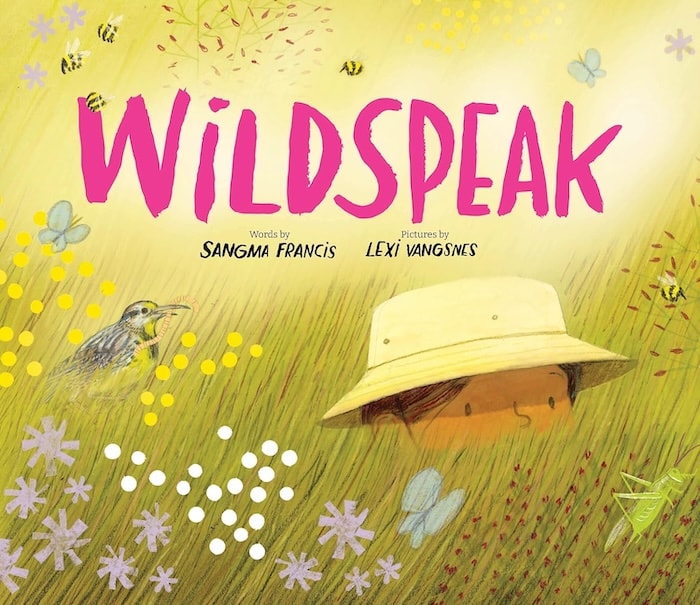
Wildspeak: Exploring Nature Through Imagination and Creative Language
Written by Sangma Francis
Illustrated by Felicita Sala
What if you could speak the language of the wild? In this gorgeous, lyrical book, Sangma Francis invites young readers to slow down, look closely, and find words for the world around them — the hush of a forest, the crash of a wave, the secret life of a beetle. Part nature guide, part poetry prompt, part love letter to the natural world, Wildspeak is a book that opens eyes, ears, and imaginations.
From the Library Director
This is one of those rare books that works as beautifully in a classroom as it does curled up alone. Sangma Francis writes with a poet's precision and a naturalist's eye, and Felicita Sala's illustrations are absolutely breathtaking — lush, layered, full of the kind of detail that rewards a second and third look. It's a natural anchor for any nature writing unit, but it also works wonderfully as a standalone read-aloud that sparks conversation about observation, language, and the way we describe the world. I've seen kids go outside after reading this and come back with notebooks full of their own 'wildspeak.' That's the best possible outcome.
Big Idea
Nature has its own language — and when we slow down, look closely, and find the right words, we become part of the conversation.
Discussion Questions
- 1
What does 'wildspeak' mean to you? What do you think the author means by exploring nature through language?
- 2
The book asks you to look closely at the natural world. What is something in nature you have never really stopped to look at carefully? What might you notice if you did?
- 3
Sangma Francis uses very specific, precise words to describe nature. Find a phrase or sentence that surprised you or made you see something in a new way.
- 4
How are Felicita Sala's illustrations different from photographs of nature? What can an illustration show that a photo might not?
- 5
The book blends science and poetry. Can you think of other ways science and art or language connect? Why might a scientist need to be a good writer?
- 6
If you were going to write your own 'wildspeak' entry about something in nature near your home or school, what would you choose? What words would you use?
- 7
The author invites readers to use their imagination to connect with nature. Why do you think imagination is important for understanding the natural world?
- 8
After reading this book, do you feel differently about the natural world around you? What might you do differently the next time you go outside?
Activity: My Wildspeak Field Journal
Students step outside — or look closely at a natural object brought inside — and practice the art of precise, imaginative nature writing, creating their own 'wildspeak' entry inspired by the book.
- 1
Go outside (or use a natural object: a leaf, a stone, a feather, a pinecone). Spend two full minutes doing nothing but observing. No writing yet — just look, listen, smell, and feel. What do you notice that you might normally walk right past?
- 2
Now write. Describe what you observed using at least three of your senses. Try to use specific, surprising words — not just 'the leaf is green' but 'the leaf is the color of a traffic light after rain.' Aim for at least five sentences.
- 3
Add a 'wildspeak' sentence: one line that gives your subject a voice or an inner life. What would this thing say if it could speak? What is it thinking? What does it want?
- 4
Illustrate your entry in the style of Felicita Sala — fill the page with detail, color, and the feeling of being close to something alive. Share your field journal entry with the class and discuss: What surprised you about what you noticed? What was hardest to put into words?
Standards Connections
CCSS.ELA-LITERACY.RL.2.4 — Describe how words and phrases supply rhythm and meaning in a story, poem, or song.
CCSS.ELA-LITERACY.RI.3.3 — Describe the relationship between a series of historical events, scientific ideas or concepts, or steps in technical procedures in a text.
CCSS.ELA-LITERACY.W.3.3 — Write narratives to develop real or imagined experiences or events using effective technique, descriptive details, and clear event sequences.
CCSS.ELA-LITERACY.W.4.3b — Use narrative techniques, such as dialogue, description, and pacing, to develop experiences and events or show the responses of characters to situations.
NGSS — Life Science: Observe and describe characteristics of living things and their environments; develop understanding of ecosystems and biodiversity.
Arts Integration — Visual literacy and illustration study: analyzing how illustrators make choices about color, composition, and detail to convey meaning and mood.
Ready to use this guide in your classroom?
Download the printable PDF with all questions and activities.