
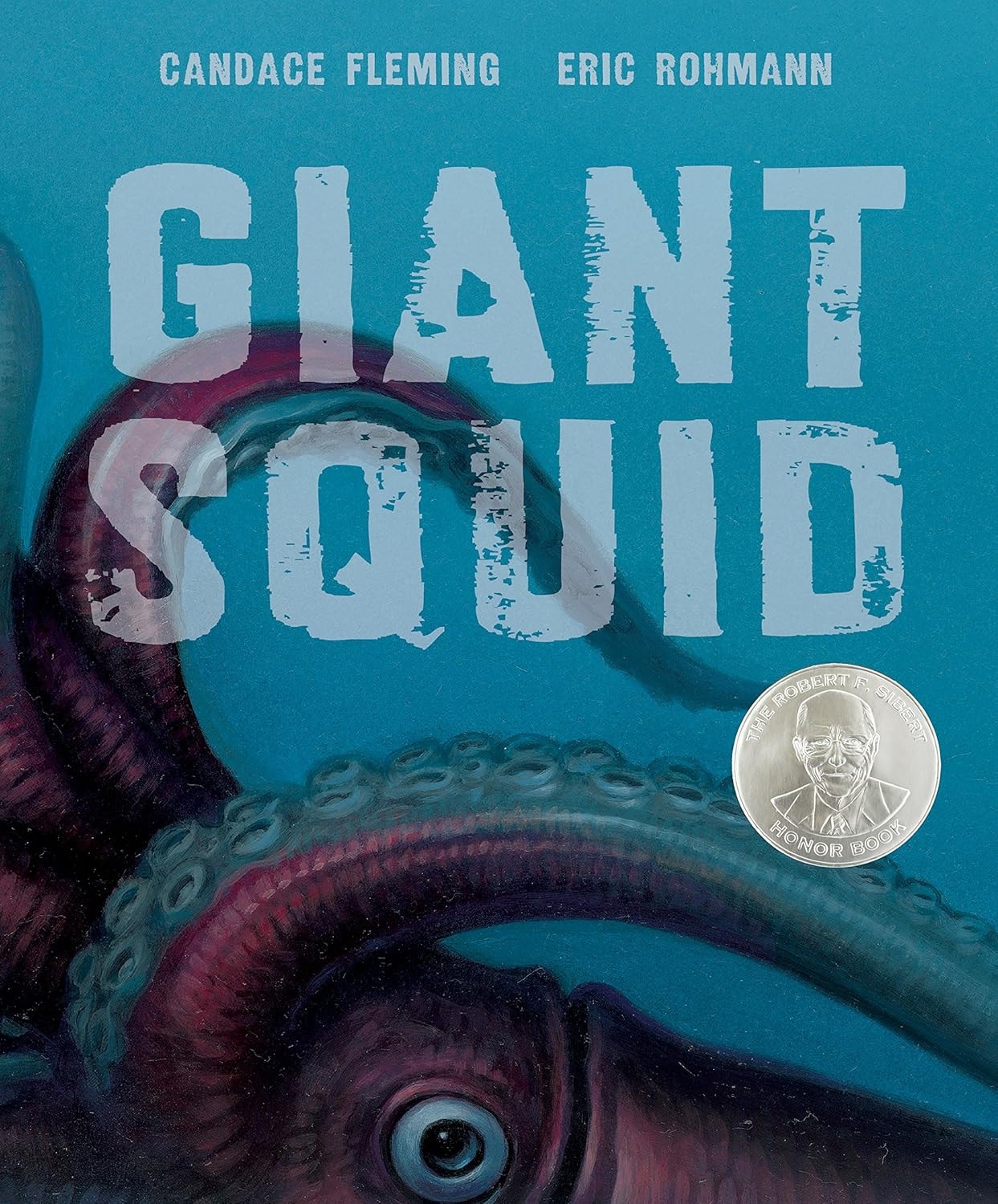
Giant Squid
Written by Candace Fleming
Illustrated by Eric Rohmann
In the pitch-black depths of the ocean lives a creature almost no one has ever seen — the giant squid. With spare, lyrical text and stunning illustrations, Candace Fleming and Eric Rohmann take readers into the deep to explore what scientists know, what they wonder, and what remains gloriously unknown about one of Earth's most mysterious animals.
From the Library Director
This is one of those rare picture books that works equally well as a read-aloud and as a mentor text for nonfiction writing. Fleming's prose is almost poetic — short, rhythmic sentences that build suspense — and Rohmann's illustrations are breathtaking. It's a natural fit for any ocean or science unit, and it opens up rich conversations about scientific inquiry, the unknown, and why mysteries are worth chasing. Kids who love creepy-cool nature content will be completely hooked.
Big Idea
Some of the most exciting science happens at the edge of what we don't yet know — and the giant squid reminds us that the ocean still holds secrets waiting to be discovered.
Discussion Questions
- 1
Why do scientists know so little about the giant squid? What makes it so hard to study?
- 2
The book describes things scientists know AND things they still wonder about. What is the difference between a fact and a question in science?
- 3
How did the illustrations make you feel about the deep ocean? What details stood out to you?
- 4
The giant squid lives in total darkness. How do you think animals adapt to living without any light?
- 5
If you were a scientist studying giant squids, what is the first question you would want to answer? How might you try to find out?
- 6
The author uses very short, simple sentences. Why do you think she wrote it that way? How does it affect the mood of the book?
- 7
Does it bother you that some things about the giant squid are still unknown? Or does the mystery make it more interesting?
- 8
What other animals or places on Earth do you think still hold big mysteries? What would you want to explore?
Activity: What We Know / What We Wonder
Students practice the scientific habit of separating known facts from open questions — a core nonfiction reading and inquiry skill modeled directly by the book's structure.
- 1
Fold a piece of paper in half. Label one side 'What Scientists KNOW about the Giant Squid' and the other side 'What Scientists Still WONDER.' As a class, flip back through the book and sort details into each column.
- 2
Choose one 'wonder' question from the book or your own list. Write it at the top of a new page. Then brainstorm: How could a scientist try to find the answer? What tools or methods might help?
- 3
Draw your giant squid in its deep-ocean habitat. Add at least two labels — one fact you learned and one question you still have.
- 4
Share your question with a partner. Discuss: Is this something that could ever be answered? What would it take? Report one idea back to the class.
Standards Connections
CCSS.ELA-LITERACY.RI.2.1 — Ask and answer such questions as who, what, where, when, why, and how to demonstrate understanding of key details in a text.
CCSS.ELA-LITERACY.RI.3.3 — Describe the relationship between a series of historical events, scientific ideas or concepts, or steps in technical procedures in a text.
CCSS.ELA-LITERACY.W.2.7 — Participate in shared research and writing projects.
CCSS.ELA-LITERACY.RI.4.6 — Compare and contrast a firsthand and secondhand account of the same event or topic.
NGSS — Life Science: Interdependent relationships in ecosystems; adaptations of organisms to their environment.
Scientific Practices — Asking questions, distinguishing between evidence and inference, and understanding the nature of scientific inquiry.
Ready to use this guide in your classroom?
Download the printable PDF with all questions and activities.